Guide · updated 2026-08-09
How to Split Bills With a Roommate Without a Spreadsheet
Stop using spreadsheets for roommate bill splitting. A dedicated household bill tracker logs each bill once, auto-converts currencies if needed, shows who owes what, and tracks settling up — without linking a bank account or maintaining a formula. You enter the bill amount, pick who paid, and the app tracks the balance and payment status. No tabs, no formula errors, no group-chat math.

Why is a spreadsheet so bad for splitting bills?
Because it was never built for this job. A spreadsheet is a static snapshot — someone has to remember to open it, update it, redo the math every time a bill changes. It doesn't flag a bill as due. It doesn't notice when a payment's late. It just sits there, blank and patient, until somebody finally does the arithmetic by hand.
You're not bad at spreadsheets. The tool is just wrong for recurring shared expenses. Your roommate covers internet one month, you cover electricity the next, and within a few weeks "who owes whom" has turned into a small archaeology project. Cross-currency households have it worse — now you're manually looking up an exchange rate and hoping the number still holds by the time you settle up.
What should I use instead of a spreadsheet?
Three things matter more than anything else: manual entry (not a budgeting app that wants your bank login), per-bill split logic, and payment-status tracking. Everything else is a nice-to-have.
- Manual entry only. You type in the bill amount and due date — no bank sync, no read access to your checking account.
- Per-bill split logic. Say "this bill is 50/50" or "this one's on me" and have the app track the resulting balance.
- Payment status tracking. See whether a bill has been paid, who paid it, and who still owes.
- Multi-currency support. If you and your roommate earn or pay in different currencies, amounts should auto-convert.
- Export capability. Get your data out as CSV any time, without a paywall.
Where does everyone else land on this? Splitwise genuinely wins on simplicity for a pure IOU — "I paid for dinner, you owe me $20." It just doesn't track recurring bills with due dates, and it has no opinion on whether your household is paying on time. YNAB, Monarch, and Copilot are excellent budgeting apps built for one person's finances, not a shared household — and they all want bank access, which is exactly what you're trying to avoid here. Fine tools. Wrong job.
How do I actually set this up in HomeWeal?
One thing before you start: splitting with someone else — inviting a roommate, per-bill split rules, the settle-up tracker — is a Family-plan feature ($14/mo or $132/yr). Solo and Pro are both single-user. If the whole point is splitting with someone, start on Family; nothing below works without it.
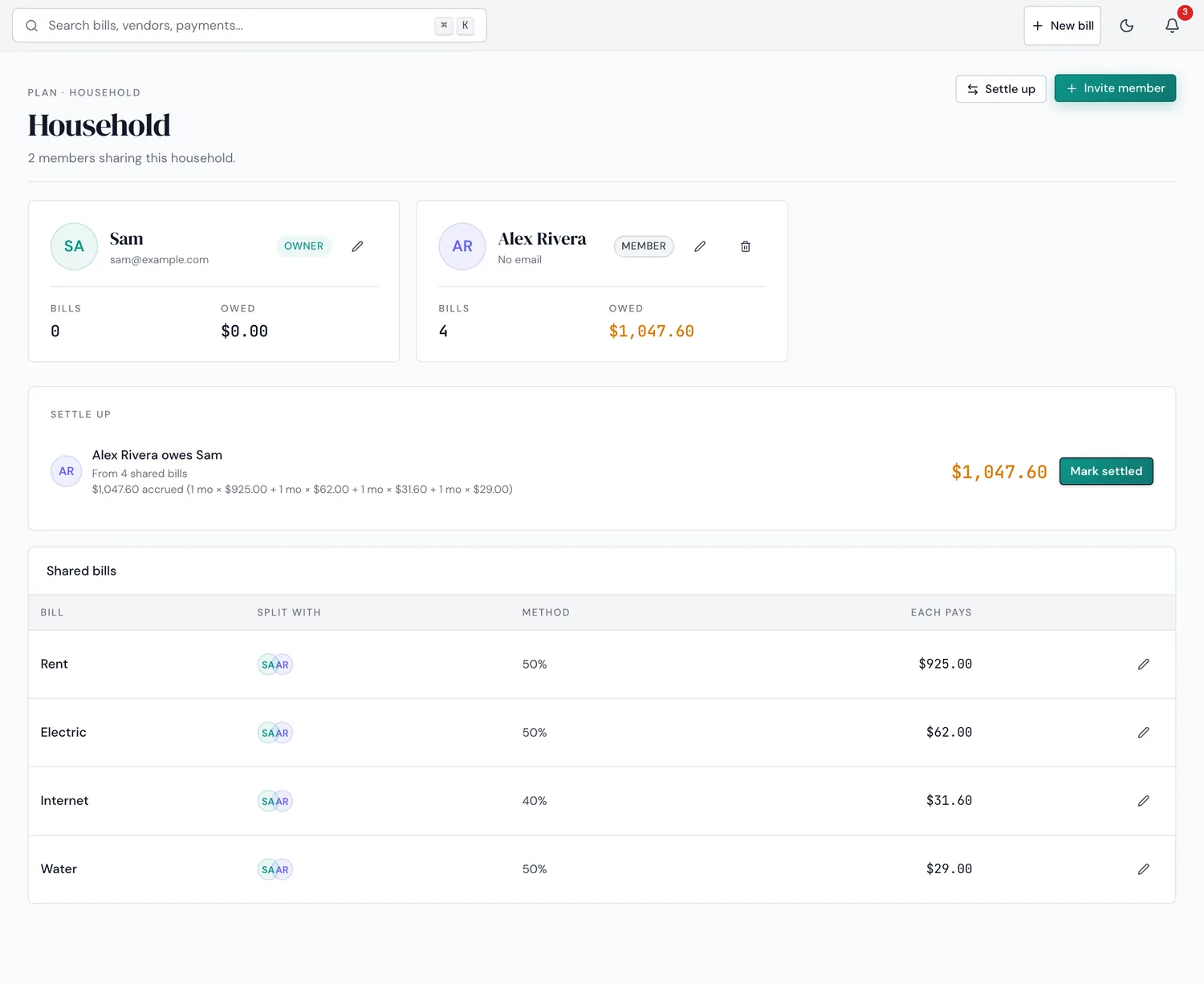
The actual Household screen — every shared bill, its split percentage, and one number for who owes whom.
- Create a household on the Family plan. Your household is isolated from any other household you might belong to. Invite your roommate by email — up to 6 members.
- Add a bill. Enter the name (e.g. "Electricity"), amount, due date, and currency. Per-bill currency means an electricity bill in GBP and rent in USD both work fine.
- Set the split. Equal split, custom percentage, or mark it "paid by one person" if you're taking turns covering the full amount.
- Mark payment status. When someone pays, mark it paid. If you covered the full bill, the app shows your roommate's share as owed.
- Check the Health Score. A 0-100 on-time payment score for the household — not a credit score, just a signal that bills are (or aren't) being paid on time.
- Settle up. The app shows the net balance; you settle in cash, Venmo, Zelle, or whatever method you prefer. It doesn't process the payment itself, just tells you who owes what.
That's the whole loop. It takes less time than opening the spreadsheet did.
What's the difference between a bill tracker and a budgeting app?
One question each. A bill tracker asks: are our shared bills paid on time and split fairly? A budgeting app asks: am I spending too much on groceries? Related questions, but not the same one — and answering the second doesn't help with the first.
HomeWeal only answers the first question, on purpose. No bank login, no categorizing your personal purchases, no gamified savings streaks. It tracks what you enter, converts currency where it needs to, and tells you who owes what. That narrowness is a privacy feature if you're living with a roommate rather than a partner — your personal spending simply isn't in scope.
Common mistakes when splitting bills with a roommate
- Using a shared card without a rule. If bills go on one card, agree explicitly who pays the statement and when the other reimburses.
- Ignoring due dates. A late bill costs more (late fees, interest) — the Health Score exists to catch this before it happens.
- Mixing personal and shared expenses. Keep the household tracker strictly for shared bills, not personal subscriptions.
- Assuming 50/50 is always fair. If income or usage differs meaningfully, a custom split may be fairer — the app supports it.
- Waiting until month-end to reconcile. Log bills as they arrive; real-time entry beats a monthly catch-up session.
Who this isn't for
Living alone, or sharing a fully joint account with a partner and not tracking individual contributions? Just pay the bills — you don't need this. Want a full budgeting tool that forecasts retirement savings and categorizes every purchase? YNAB or Monarch genuinely do that better. Splitting a one-off dinner with friends rather than a recurring bill? Use Splitwise — free, simple, built for exactly that. HomeWeal is for the bill that comes back every month, not the restaurant tab.
Bottom line
If you live with a roommate and share recurring bills, a dedicated tracker beats a spreadsheet on time and accuracy. Splitting requires the Family plan ($14/mo or $132/yr, early-bird locked) — billed pay-now with a 30-day money-back guarantee, no free trial. If you just want to track your own bills first, Solo is free forever, up to 10 bills.